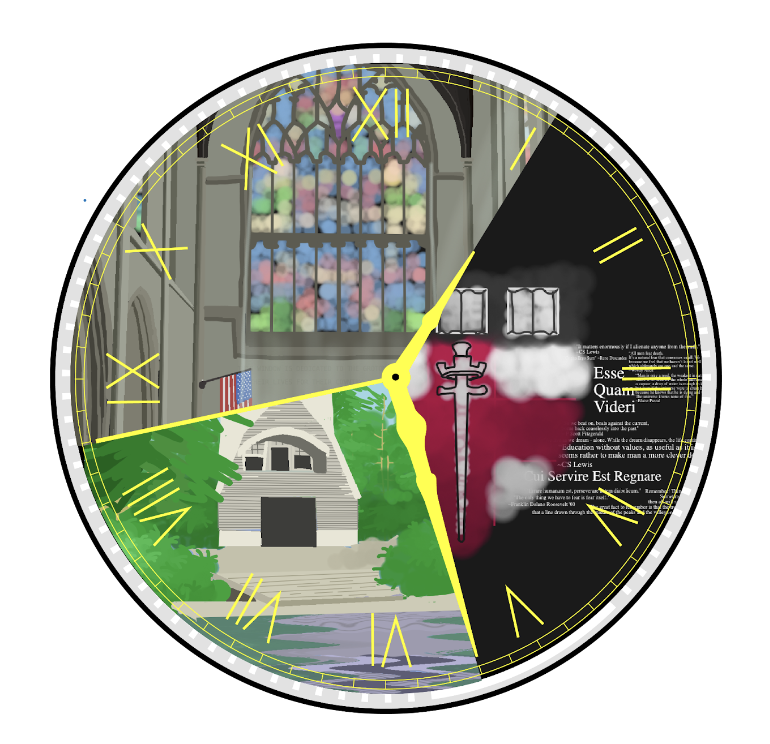
On the brisk Saturday morning of September 20, students, faculty, alumni, and former teachers gathered in the Campbell Performing Arts Center to celebrate a transformative milestone: the school’s 50th year of coeducation. In place of morning Chapel, a panel of alumni and former faculty members—Pam Clarke, Bill Polk, LuAnn Polk, David Bannard, Ben Pyne ’77, Alyce Jones Lee ’77, and Naomi Pollock ’77—answered questions from the senior prefects about their experiences. Panels continued throughout the day, focused on women’s athletics, gender equality in STEM, and the architects who made the transition possible.
“There are moments at this school where you feel that there’s a leap of faith. Those of us who do science call them ‘quantum leaps.’ You are witnesses to this progress,” said Headmaster Temba Maqubela at the start of the “Groton’s Coeducation Journey” panel. “We are a better school today because a decision was made not only by the pioneers who came, but also by the architects who said, ‘The time to change is now.’”
In many ways, the headmaster’s remarks echoed the sentiment of the day: community building and progress. However, the path to coeducation was not a single leap of faith, but rather the culmination of efforts by countless trailblazers—students, and faculty who committed themselves to the goal of coeducation.
Sixth headmaster Bill Polk ’58 was one of these innovators. As a senior prefect, Mr. Polk was opposed to coeducation, but after he returned to the school as headmaster, he became one of its most fervent supporters. The reason for this change lay in his experiences at graduate school: “I saw women who were leaders in the class, leaders in the community, who were just wonderful models of what education should be at its best.”
Before Mr. Polk assumed the role of headmaster, he served on the Board of Trustees, at which time he oversaw the founding of a special committee dedicated to researching the possibility of coeducation. This effort ultimately paved the way for coeducation to begin in 1971.
Even after the committee finalized the decision, some members of Groton’s community remained opposed to the change. “Someone in the community said, ‘We will love them into submission,’” recalled Mr. Polk. “And that’s what we did.”
Even among those who initially disagreed with the initiative, it became clear that the decision to bring coeducation to Groton also broadened the school’s reach and enhanced the overall caliber of the student body. “There were two schools that held out, and they finally went to coeducation because as a single-sex school, their admissions dried up, and the quality of their applicants was not what it had been,” noted Mr. Polk.
While these administrative considerations shaped the school’s broader direction, the heart of Groton’s leap to coeducation lies in the perspectives of the students themselves. Alyce Jones Lee ’77 was a double pioneer, both as a woman and a person of color. She believes that the opportunity to attend Groton had a profound impact on her life.
“I was not in a great situation at home,” she said. “The opportunity to come to Groton, I thought it was an answer to my prayers. Suddenly, this man who taught at Cathedral High School, where I went to school, came to our family store and told us, ‘Groton is going co-ed next year.’ And he had gone to the school and asked for the names of two African-American girls who were high-performing. And I was one of them.”
As part of the first class of women at Groton, Ms. Lee found that the community, especially the students of color, was greatly welcoming to her. One of the most memorable moments, she notes, was that upon arriving, she was greeted by a group of boys who helped carry her bags, and eventually became her first friends at the school.
To Ms. Lee, as someone from a working-class family, being successful at Groton meant a great deal.
“Coming here totally changed the trajectory of my life,” she said. “The opportunities that were afforded to me, just by virtue of coming here, have allowed me to have two things. I can afford to have a family with love. I can afford to have a family that, because I’ve always been able to feed and educate them, and nourish their minds, that they actually grow up with their own personal dignity and their own sense of themselves as people who matter and make a difference.”
Naomi Pollock ’77 also felt that choosing to come to Groton was an unforeseen yet fortunate decision. During her visit, a snowstorm struck and left her stranded on campus for an extra day—an experience that led to her falling in love with the school.
“The next morning, when we woke up, there was snow everywhere,” she said. “What were we gonna do? So my mother said to call Pam.”
Pamela Clarke, then an English teacher at Groton, graciously delivered the news: Pollock would get to spend a day sitting in on classes at Groton. “The next morning, my mother and I just looked at each other and sort of said, ‘Well, that decides that,’ because we’d been so persuaded by that second day. So I really applaud what Pam Clarke did to make us feel like there was a place for us. Even if you visited the school and it didn’t look like there would be a place for you, she was reassuring.”
Ms. Clarke was the first female teacher at Groton hired without a faculty husband.
“Paul Wright hired me in 1972,” she explained. “He was the kindest person I think I have ever met. We were chatting along, and I was convincing him that, having majored in ancient Greek and read all the really good literature in the original, I should come here and teach English. He was kind enough to buy that argument and remarked to me that other schools were going coed, and we would probably be going coed sometime too, so perhaps we should try one.”
The Circle soon began to adjust to this new normal. Ms. Clarke’s time at Groton was marked by her efforts in New York to bring more girls to Groton. “We stole girls all over New York,” she said humorously.
As the day progressed, the Groton community gathered for other various panels. In the morning, the whole Groton student body joined the “Stories from the Fall of 1975” session, which brought together five Groton alums from the Forms of 1977 to 1980, sharing what it was like to be a new student as co-education began. They reminisced, shared laughter, and reflected upon the challenges and excitements of the time.
“Social success was getting any of these women to dance with you,” said former student and current trustee Kevin Griffith ’80, to much laughter. He had landed at Groton as a Second Form student in 1975. “People don’t have an appreciation for what cubicles were like. You had a bed, a wooden chair, a bureau, four hooks on the wall, and a blue or red curtain that didn’t go all the way to the floor,” he recalled. “I’d like to thank the girls for coming and bringing some more civility to living spaces.”
In the panel “Grotonians in Medicine and STEM,” four Groton alumni working in medicine and STEM came together to discuss their journeys and the challenges that come with being a woman in traditionally male-dominated fields of study and work. For panelist Amy Baughman ’99, her experience in the Environmental Medicine class taught by David Black, PhD, ’80 inspired her to help others through a career in health care.
“Our project in that class showed there were very large amounts of fertilizer runoff that were creating a lot of growth,” said Ms. Baughman, and, as she later found out, “he was able to use that information to do something good for the community.”
Panelist Mimi Sotiriou Raygorodetsky ’94, who runs an environmental engineering firm out of New York, felt STEM at Groton eroded the gender barrier: “I credit Groton with creating an atmosphere where we were all comfortable to choose to study in STEM fields.”
During the “Athletics at Groton” panel, moderated by Classics faculty member Preston Bannard ’01, a mix of past and present faculty and alumni from the past 50 years, including Jenny Polynice ’25, Jaden Adinkrah ’23, and Amy Frothingham Ford ’78, testified to the positive effect Groton athletics had on their experiences.
Ms. Adinkrah, who played soccer, basketball, and was a track and field captain, said, “My experience here as far as an athlete has always been looking at sports as an opportunity to express myself in a very seen way.”
Hope Prockop ’86, who is now an international squash referee, said her 43-year career in the sport began at Groton. She credits the Cornelia Frommingham Award with “plant[ing] a seed in me that remains today, sort of remembering how important leadership is and service is to sport.” She now devotes herself to promoting female representation in squash.
In addition to athletics, new girls at Groton found comfort in the Visual and Performing Arts Departments, where they thrived. As former choirmaster Daniel Hathaway said in the panel “A Coeducational Reflection on Groton’s Arts Program,” the “treble line became much more powerful and serious,” a change which he felt strengthened the choir program significantly.
Theater Department Head Laurie Sales echoed this sentiment, pointing out that the stagecraft program is now predominantly girls.
“There’s nothing more exciting than walking into a scene shop and seeing all these women welding, building things, helping each other to figure out how to use their math and science in this space,” she said.
It is easy to take the coeducational Groton we have now for granted, or to look at the decades-old change to coeducation as the flicking of a switch, but to do so ignores the tireless efforts of pioneers and architects to make this current Circle a reality. As those same pioneers and architects return to Groton a half-century later, they invite us to celebrate a more inclusive and welcoming world, one that was created when the first class of girls arrived at Groton in 1975. In doing so, they invite us to consider the work still to be done in furthering social justice at Groton—to, in the words of Mr. Maqubela, “collectively ask ourselves: does that optimism, openness, and dynamism to forge new paths still exist today?”